Search This Blog

Thursday, July 31, 2025

Species Fact Profile: Giant Isopod (Bathynomus giganteus)

                                                        Giant Isopod

                                  Bathynomus giganteus (A. Milne-Edwards, 1879)

Range: Western Atlantic Ocean (includes Caribbean Sea, Gulf of Mexico)
Habitat: Ocean Depths up to 2140 Meters
Diet: Detritus, Carrion
Social Grouping: Congregate around food sources
Reproduction: Reproduction believed to peak in spring and summer, when more food is available.    Lay 20-30 eggs, believed to be the largest of any marine invertebrate at 10 centimeters in diameter.  Females develop pouches in which eggs are stored until the young emerge as miniature adults, 6 centimeters long, having undergone their larval stage in the pouch.
Lifespan: 40-60 Years
      Conservation Status: Not Evaluated

  • Body length up to 50 centimeters (more commonly 19-36), with rumored lengths as long as 75 centimeters.  Flattened body is covered with rigid exoskeleton of overlapping segments.  First segment is fused to the head as shield.  Seven pairs of legs, the first set being the pereopods, used to move food into the jaws
  • Large, compound eyes have approximately 4000 facets, with a reflective lens at the back to allow for improved vision in dark conditions.  Also have two pairs of antennae
  • Pale lilac or pink in color, often appears white when seen in aquariums
  • Primarily scavengers, but will prey on slow-moving/immobile animals, such as sea cucumbers and sponges, or attack fish caught in traps
  • Capable of going long periods of time without eating, with one captive have been recorded as going 5 years without feeding.  When food is found, they can gorge themselves to such an extent that they may have difficulty moving
  • When threatened, curl into a ball leaving only their tough exterior exposed.  Burrow into sediment for shelter.
  • Species has been reported in the Indo-Pacific Ocean before, though this is now believed to have been a misidentification of a different species (there are several species of giant marine isopod around the world)
  • No significant commercial demand, but sometimes bycatch in trawls

Tuesday, July 29, 2025

The Wading Pool

 The variety of species that zoos and aquariums are likely to exhibit in the near future is probably not going to increase dramatically.  If anything, it will probably decrease, as animals which are not in sustainable populations or cannot be sourced legally and ethically from the wild (such as rescue/rehab cases) fizzle out.  As such, I think one of the big challenges in the future of zoos is going to be coming up with ways to exhibit animals already present in their facilities in new and exciting ways.

There have been many innovations over the years, including nocturnal lighting, underwater viewing, rotating exhibits, and the development of the safari park.  Another concept is the possibility of allowing visitors to share space with an increasing variety of animals.  Such was the idea recently unveiled in some concept art from the Denver Zoo, proposing a new exhibit.


When I first saw this picture, I thought that the young lady in the pool had her legs crossed and was, for some reason, drawn sitting on top of the water's surface.  Then I looked closer, and realized that those aren't her legs.  She's wading in the water with a capybara.  That... is a possibility for an exhibit that I hadn't thought of before.  Mostly because capybaras, Lord Love 'Em, can be kinda gross, and tend to view their bathing areas as being the same as their pooping areas.  It looks like both of the people in the water are wearing waders of some sort, so maybe those will be standard issue to keep visitors clean?  Or maybe this space is envisioned as being separate from the main capybara habitat, with the idea that the capys will only have access to this space for programs, and hopefully get the poop out of their system elsewhere?

It's innovative, I'll give them that, and while I'm not 100% sold on the idea, I like the outside-of-the-box thinking.  Capybara are traditionally viewed as a filler species in zoos, an accompaniment to "cooler" South America species, like jaguars and monkeys.  Which is weird, in a way, because people love capybaras - there's a capybara cafe experience in Florida, for heaven's sake.  Sometimes it seems that only zoo folks treat them as boring.  And so, it's pretty cool to see a plan for an exhibit that takes this "filler" species and makes it the star. 


Monday, July 28, 2025

Leatherback on a Leash

Some species have historically proven very difficult to keep in zoos and aquariums, and those are typically species that zoos do not deliberately work with.  Sometimes, however, an animal in need shows up at your doorstep, and when it does, you can be sure that the dedicated zoo staff will do all that they can to help.  Consider this interesting case study ongoing at the Brevard Zoo in Florida.


Whereas many sea turtles adapt well to life in aquariums, the largest and most spectacular species, the leatherback, typically does not.  This is largely due to their pelagic nature - the species can't seem to stop itself from swimming into the walls of tanks, injuring itself (the challenges of keeping this species are detailed in The Captive Sea by Craig Phillips of the Miami Seaquarium).  When this little guy, suffering from a jaw injury, was brought to the zoo's turtle hospital, creative solutions were required.  Video footage can be found here (I haven't figured out a way to embed Facebook reels).

The string on the turtle's shell allows the turtle to swim, but not too close to the walls of the tub where he could collide.  It wouldn't be an ideal method of keeping an adult leatherback turtle long term, so does nothing to address the challenge of keeping adults in aquariums - but that's not the goal here.  The hope is that the hatchling will soon be well enough to be released, and then can swim as far as it wants to in any direction, without fear of crashing into anything.  

Saturday, July 26, 2025

You Know You're a Zookeeper When...

Always a popular train of thought, here are some contributions from Animals Anonymous Apparel to round out NZKW 2025!


Friday, July 25, 2025

Book Review: A Zoo In My Luggage

Among my favorite animal-focused authors of all time is the British naturalist Gerald Durrell.  Durrell was a prolific writer who authored several books, most of which can be divided into two categories.  There are the books he wrote about his youthful days as an animal collector, hacking his way through the forests of Africa and South America in search of mostly small, obscure beasts.  And there are the books about his later life, in which he established his own zoo on Jersey in the Channel Islands, a zoo which today bears his name.  

And then there is the book the bridges the gap, when he transitioned from one to the other.

A Zoo In My Luggage details one of Durrell's expeditions to his favorite hunting grounds of Cameroon, where he trapped animals in the domain of his good friend and the local ruler, the gin-slinging Fon of Bafut.  (I found the first chapter to be one of the more amusing ones - Durrell, already a celebrated author at this point, had written about his previous adventures in the Fon's domain, and upon his return to Cameroon, suddenly found himself worried that his friend might object to his depictions in my book.  Fortunately, the Fon had a good sense of humor and was delighted at being immortalized in literature).   Readers with more modern sensibilities may show some distaste for the concept of collecting in colonial Africa, with all of the racial undertones that are inescapable in such interactions, but Durrell's genuine appreciation for Africa and Africans - as actual people, not as stock characters - seemed clear to me (and his writing is more mature than it is in some of his earlier writing, perhaps as he became more confident and familiar with Africa)

The first portion of the book details Durrell, his (first) wife, Jackie, and their team as they collect a representative sample of Cameroonian wildlife. Unlike past expeditions, however, Durrell wasn't planning on off-loading his collection to British zoos at the end of the trip.  Instead, he decided it was time to start there own.

As Durrell himself cheerfully admits, any sane person would have found the site for a zoo first, and then built the facilities, and then, and only then, actually gone out and gotten the animals.  Durrell... did not do that.  Instead, he parked his mobile zoo in his sister's garden, and then set out to find a home for it, sure as could be that some government would be delighted to welcome him.

I've described much of the story of how Durrell eventually found a home for his animals and his family elsewhere in this blog, and it remains one of my favorite zoo stories, so no need to rehash it hear.  What I mostly remember about this book is the sense of joy in watching someone fulfill their dream, which just so happened to be a dream that I'd also shared for so long.  I don't expect to be starting up my own zoo any day now - not unless someone leaves a duffel bag of gold bars on my doorstep one morning - but I can still live vicariously through the story of a young man who loved wildlife and wanted to spend his life with animals, and who, against outrageous odds (some self-inflicted) went on to create an institution which has outlasted him as a force for good for animals all over the world.

A Zoo In My Luggage at Good Reads


Thursday, July 24, 2025

The Reason for the Season

It's been said that if your job as a designated "Appreciation Week," it probably means that you aren't being paid enough.  After all, whoever heard of National CEO Week, or Captains of Industry Week?  It's certainly true for zookeepers and aquarists, which might be the reason that members of our field tend to make such a big to-do every NZKW every July.

But exactly what to do with that week is sometimes subject to debate.  There are some zoos that see it as an educational opportunity, with lots of events highlighting keepers to the public, heavy social media exposure, maybe events or even a "Zookeeper Camp."  This can be a big hit with the public, but can also seriously add to the keepers' workload, and leave them always feeling "on."

Other zoos respond by thinking of it more as a week for the keepers.  They respond by dumping loads of cake, ice cream, and pizza on their keepers, hoping for the best.  This is generally appreciated... but you also hear a lot of cranky keepers comment that it a pizza party now and then doesn't make up for the low pay and tough conditions.  

I've worked at zoos at both extremes, as well as some where I'm pretty sure management never even heard of the concept of zookeeper week.  At each facility, I always felt like there were lots of keepers who were dissatisfied at the end of the week - keepers who felt like there should have been something more, whether its more appreciation, more money (never going to happen), or more validation that all of the struggle and sacrifice is worthwhile.

I was recently reminded, however, that National Zookeeper Week isn't the brainchild of the zoos themselves, nor of any of our governing bodies or accrediting associations.  It was created for keepers, to celebrate keepers.  It's not a pat on the head and acknowledgement from the outside world.  It's members of the zoo community lifting each other up and saying, "We see what you do, and we appreciate it."

This cake was baked by a keeper at a zoo where I worked years ago, a tiny unaccredited zoo, shoddy in both its build and its management.  The only way we made it through each week was by supporting each other as a team.  The zoo director and the zoo owner didn't acknowledge the week - we decided to celebrate it ourselves, and one keeper baked this cake for us to share at lunch one day.  It remains, in my memory, the most satisfying, meaningful National Zookeeper Week treat I've ever had.

Tuesday, July 22, 2025

Long Live the Weird

The four-eyed fish is not a particular rare species, either in the wild or in zoo and aquarium collections.  There is no need to manage a insurance population in hopes of eventually reintroducing specimens to the wild.  Instead, most aquariums that keep the species do so for one, simple reason.  It's weird.  

And that's ok.

Accredited zoos and aquariums lean so heavily into their conservation messaging that sometimes I feel like they become trapped by it.  In the eyes of some members of the public - including those who are hypercritical of zoos - if a species is not critically endangered and being bred for reintroduction, than there's no real purpose in managing a captive population.

The adaptations of the four-eyed fish aren't monstrous or bizarre - they serve to help is survive in a challenging habitat where different ecosystems converge and a fish needs to know what's going on above and below the surface if it's going to survive.  Other fish from around the globe.  have responded to similar environmental challenges in different ways - like mudskippers and lungfish.  At a very superficial level, looking at an animal like a four-eyed fish is a step above a old circus freak show, and some visitors do treat it like that - Look at the weird-looking animal, isn't it strange/gross/funny?  At a deeper level, it can encourage visitors to appreciate and understand unique adaptations, explore evolution, and maybe consider how closely-linked animals are to their environment, and how their survival depends on the preservation of those wild places.

Zoos are about more than just direct conservation, however (and conservation is about more than release programs).  They also serve as places for people to study and appreciate animals.  A major way of doing that is to hook people (fishing pun unintended) with some of the strangest and most unusual species.  Freshwater fish are among the most endangered of vertebrates, but they often are some of the most overlooked of animals in zoos - where they are at best usually an accompaniment to mammals, birds, and herps - and aquariums - where the focus is often on large marine species, especially sharks.  By using some of the most unusual examples of fish, staff can help elicit interest in other, more endangered, but perhaps more... conventional fish species.

A zoo, or aquarium, or botanical garden is a place to celebrate biodiversity.  And a big part of biodiversity is made up of the weird little species that seem to strange to believe in.

Saturday, July 19, 2025

Species Fact Profile: Largescale Four-Eyed Fish (Anableps anableps)

                                                    Largescale Four-Eyed Fish

                                               Anableps anableps (Linnaeus, 1758)

Range: Northern South America, Trinidad
Habitat: Estuaries, Mangroves, Mudflats
Diet: Insects, Small Crustaceans, Mollusks, Diatoms
Social Grouping: Schools of 10-50 individuals
Reproduction: Breed year round, multiple times per year.  Internal fertilization.  Females carry 1-37 eggs which they retain internally, give live birth.  Sexes have asymmetrical genitalia, bending either to the right or left, and as such not all males in the species are sexually compatible with all females.
Lifespan: 6-8 Years
      Conservation Status: IUCN Least Concern

  • Grow 14-18 (but up to 25) centimeters long, weigh 30-80 (but up to 200) grams.  Females larger than males.  Slender, elongated fish
  • Brownish-gray coloration with some countershading, 3-5 brown-purple lateral stripes
  • Despite the common name, the fish does not actually have four eyes - instead, each of the two eyes is divided with a horizontal band of tissue into two lobes, each with its own pupil.  The fish is then able to see above and below the water at the same time.  Most periodically submerge completely to prevent the surface-viewing eyes from drying out
  • Sometimes comes out onto land to feed on mudbanks
  • More tolerant of freshwater than other four-eyed fish, and can sometimes be found considerable distance inland, taking advantage of high tides to venture into intertidal channels
  • Genus and species names both come from the Greek for "Glancing Up"

Friday, July 18, 2025

Rod and Reel

It's strange, but of all of the things that I disliked about Wonders of Wildlife Museum and Aquarium, the heavy emphasis on fishing didn't strike me at all as overdone or too heavy-handed.  Which is surprising, because it was not a subtle presence there.  From the bass fishing hall of fame to the display on US Presidents and their fishing fetishes, love for the sport was omnipresent through the building, as one might expect from an aquarium that was paid for with Bass Pro money.  It got to the point that, when I walked by the shark tank, I expected a hook and line to drop into view any second.


Fishing is just so closely associated with our ties to fish that it feels natural that a building displaying aquatic creatures - and especially one that focuses so heavily on freshwater fish - would talk a lot about it.  If anything, it enhanced the aquarium experience for me a bit by offering something unique, a new take on river and lake and ocean ecosystems.  These elements were interspersed among the aquarium displays, but were segregated enough that, if you did not have any interest in them, you could breeze through them without any difficulty and head straight to the next tank.  The emphasis on the ties between fishing and conservation is made throughout the aquarium.


I can certainly see why some visitors might find the focus on fishing to be off-putting.  I imagine it would be weird going to a zoo that was themed around big game hunting (though again, the Heads and Horns Museum at the Bronx Zoo was once of the signature attractions of that august facility, which was founded in large part by... big game hunters.  That collection is now on display at Wonders of Wildlife).  That being said, issues pertaining to conservation tend to be complex, especially when the welfare of individual animals (which, presumably, would not like to be fished and/or hunted) are added to the mix.  Rather than not talking about hunting and fishing at all, it was interesting to be in an aquarium that does discuss it...

...even if they have a vested financial interest in promoting it.

Wednesday, July 16, 2025

Zoo Review: Wonders of Wildlife Museum and Aquarium, Part II

Perhaps the (live animal) exhibit area that I have the most vivid memories of from my visit to Johnny Morris Wonders of Wildlife Museum and Aquarium is the Swamp by Night.  It's a darkened, two-tiered habitat in which visitors meander across rope bridges through darkened hallways to see a variety of wetland creatures, including owls (visible from inside a hunters blind) and North American river otters, in one of those all-indoor aquarium exhibits that I've come to dislike so much.  There are also several reptiles and invertebrates here, including one of the stranger rattlesnake exhibits I've ever seen, which is actually set into the floor of the hallway, with visitors walking over it.  I had so many questions about that exhibit, including how keepers service it and what sorts of protections are in place to buffer the snakes - notoriously sensitive to vibrations, from visitors stomping all over the roof of their exhibit, deliberately or otherwise (which I suspect happens a lot).  Giant fish, such as alligator gar and paddlefish, can also be observed.

And, like any swamp exhibit worth its Spanish moss, there are alligators - including a white alligator, which were tremendous novelties when I was a kid, but their explosion in numbers and availability have somewhat diluted the experience.  The alligators are seen in the lower level of the swamp habitat, though they may be initially glimpsed from the upper level (again confusing me a little, as I was unsure how to get to them).  This lower level also features beavers (visible either underwater or with a window into their lodge), waterfowl, and another view of the gar, catfish, and other giant river fish.  There was an indoor/outdoor habitat for American black bears, though I believe the aquarium has recently lost this species and is looking to repurpose that exhibit space for another species.  And, in what was a somewhat disappointing addition, there was the smallest and, if I'm going to be blunt, worst habitat for lesser flamingos (or any flamingos) I think I'd ever seen - small flock, small exhibit, and nocturnal - who does a nocturnal flamingo exhibit?  And why African/South Asian birds in an otherwise North American exhibit?  Black- or yellow-crowned night heron would have been a more appropriate fit.

Another freshwater habitat is tackled in the Amazon area, this one more conventional.  There's a decent collection of freshwater fish and herps, covering most of the usual suspects that you see in Amazon exhibits in aquariums - electric eel, piranha, matamata, green anaconda, dart frogs.  Birds and mammals get slight representation with aracaris and marmosets.  Nearby is a cave of fruit bats.  Like other exhibit areas, this was a bit confusing, and here I had to do some doubling-back to make sure I didn't miss any of the smaller exhibits.

Surprisingly, past the entrance there aren't too many saltwater exhibits.  There are some jellyfish, and a coral reef tank, and some small side tanks.  The classic shark-and-sea turtle-tank, usually the crown jewel of any aquarium, is actually fairly small and wasn't terribly impressive or well-highlighted.  Interspersed between these exhibits are more displays on fishing, including a Bass Fishing Hall of game, as well as an admittedly impressive display of sea shells.  Visitors eventually find themselves back at the stingray touch pool that they observed towards the beginning of their trip (this time at level with the tank, at the base of the towering cylindrical Shipwreck Reef that it surrounds) before returning to the lobby.  From here, they can access the Wildlife (taxidermy) Galleries, among which the penguins are tucked away.

I left Wonders of Wildlife with two competing but not-quite contradictory impressions.  First, parts of it were beautiful - the Swamp by Night was visually striking as was the Mangroves (though here, as elsewhere in the aquarium, the décor sometimes overpowered the exhibits), I thought Shipwreck Reef was very attractive, especially the first view from above, and it definitely had a distinctive feel compared to many of the aquariums I've been to, many of which feel, as I've said, very similar.  The second was that I didn't especially like it.  It felt like it would have been a cool place to host an event, and if I were making a movie or TV series that had a scene set in an aquarium it would have made awesome scenery.  But as a place to actually see the animals and observe and admire them, I felt like it left something to be desired.  Signage was pretty bad (even by aquarium standards) and visibility in some cases worse.

This was really driven home for me at the River Monsters tunnel, home to large freshwater fish from around the world.  It was just so dark!  A large fish was right in front of me - the signage that was present narrowed it down to arapaima and alligator gar, two species I've seen plenty of times in large aquariums and should know on sight - but it was just so dark that I couldn't tell what it was.  Similarly the snake-in-the-floor exhibit.  How am I supposed to actually see the snake when people are walking over the only viewing portal constantly?

I didn't find the inclusion of fishing exhibits to bother me, even if they didn't terribly interest me, and the taxidermy galleries I (mostly) found quite good.  Still, Wonders of Wildlife struck me as a facility that was more focused on its aesthetics than its animals, and I could easily see a visitor leaving impressed by the visual experience and uniqueness of the display, without really having seen the animals.  So essentially... I wasn't WoWed.  

Tuesday, July 15, 2025

Zoo Review: Wonders of Wildlife Museum and Aquarium, Part I

I've commented before that there is a tendency for many aquariums to closely resemble one another.  There are reasons for this; there are only so many ways that you can respond to the challenges and limitations of keeping aquatic animals, and the list of which aquatic species are available for aquariums and do well under human care has its limitations.  As a result, many aquariums tend to look alike, both in terms of their species list and their exhibits.  Every once in a while, however, you come across a particularly unusual facility.  One such aquarium is Johnny Morris Wonders of Wildlife Museum and Aquarium - we'll just call it Wonders of Wildlife for simplicity.

Located in Springfield, Missouri, this is one of the newest major aquariums in the United States; a smaller proto-aquarium opened up in 2001, before opening in its expanded, massive new form in 2017.  The aquarium's namesake and founder is John Morris (also of Springfield), who founded the popular fishing supply store Bass Pro Shops; indeed, there is one megastore attached to the aquarium.  Many Bass Pro stores also feature aquariums and other live animal displays (earlier that year, I'd visited the one in Memphis, Tennessee), but none to this scale.  

As the full name of the facility would suggest, there is a strong focus not just on the aquatic animal aspect, but a museum as well, focusing on America's hunting tradition.  For example, there is a special gallery of US Presidents and their fondness for fishing, with memorabilia from anglers-in-chief (both George W. Bush and Jimmy Garter attended the opening of the museum and have some of their personal effects on display here).  There are displays on the history of hunting and its involvement in conservation in America (special focus on Teddy Roosevelt), but also on taxidermy, with very impressive displays of North American and African wildlife, as well as the mountain sheep and goats of the world.  These dioramas surpass many of the natural history museums I've been to in their quality and realism.  Some of the exhibits are a little... eccentric, such as a sculpture of a deer made out of antlers.  Others are breathtaking, like wolves hunting muskox under the northern lights.  Zoo history buffs will be delighted to see the Heads and Horns Museum, once a feature of the Bronx Zoo in its earliest days, now relocated here.

All of these exhibits, museum and aquarium, are included in admission.  If you are only interested in live animal exhibits, be aware that one of the most popular animal habitats, a sub-Antarctic display of gentoo penguins, is located tucked amidst the taxidermy displays (what WoW calls the Wildlife Galleries) and could easily be missed if you weren't planning on following the galleries into that section of the building.

The aquarium itself follows a single path, typical of how many aquariums are designed these days, which is probably for the best in this case.  The visitor experience maneuvers up and down between floors; at times you'll glance an exhibit from one level, be unsure as to how you're supposed to reach it, and follow the path along, only to eventually wind up there later.  The entrance to the facility is certainly one of the more grandiose experiences - a large, dark blue hallway with boats (including one belonging to Ernest Hemingway, another notable angler - if Old Man and the Sea wasn't enough of a giveaway) and life-sized models of whales serving as decorations.

The aquarium exhibit opens up with a massive bait ball exhibit (a swarm of small schooling fish, used by many aquariums to open with a burst of action and motion) before coming to a tank styled around Australia's Great Barrier Reef.  Visitors then walk alongside a large, ring-shaped tank that features smaller sharks, allowing guests to walk alongside the cartilaginous fish as the circle in constant motion.  Next is a towering tank of groupers and other species in what is called the Shipwreck Reef, seen from a catwalk nearby, while at the base of the tank is a stingray touch pool (which you do not access from up here - I did see a lot of visitors trying to puzzle out how to get down there).

I'm increasingly finding it difficult to describe WoW in a straightforward manner of a narrative walk through, so when we resume tomorrow, it'll probably just end up being more of a conversation about the exhibits rather than a guided tour.  Even with the map in front of me to help walk through the exhibits, I still feel like I'm getting lost.

Wonders of Wildlife Museum and Aquarium

Saturday, July 12, 2025

The Neotenic Bear

The concept of animals like tiger salamanders experiencing neoteny - staying as perpetual juveniles - is a fascinating biological principle.  But what if it applied to other animals?

When I first started in zookeeping, the zoo that I worked at had an old bear exhibit.  Well, not that old, really - it was built in the 1980s - but with its small size and relatively stark features (like many "natural" bear exhibits of that era, it was mock-rock and a waterfall-fed pool), its limitations were becoming quite known to us.  The brother-sister pair of American black bears that lived in it had seemed perfectly content when they were acquired as cubs - small, easily amused with toys and enrichment - but now that they had grown, the exhibit was seen as increasingly unsatisfactory.

"It's too bad that they don't have a pygmy bear that just stays the size of a cub," one keeper remarked to me one day as we walked by the viewing windows.

I pondered that for a moment.  "I think that's just a raccoon," I replied.
More than once in my career, I wished that I could just hit the pause button on an animal's development and keep it frozen in time.  Usually it would be to keep an animal young when its fun and playful; many species grow more aggressive with age (cassowaries, for example, are allowed to freely wander the village streets of their native New Guinea as youngsters, before they became savage as adults).  At other times, it would be fun to pause an animal at one time of year - some ungulates I've worked with, for example, have been perfectly pleasant for much of the year, but become monsters during rut, to the point where it would no longer be safe to share space with them.

That, of course, all limits oneself to the fantasy that you could just hit "pause" and not "rewind" - because the greatest pleasure then would be to watch your animal live of its life, learn from it, and then, towards the end, go back to the beginning to do it all again, but doing better with the lessons you've learned.
Thursday, July 10, 2025

Put a Tiger in Your Tank

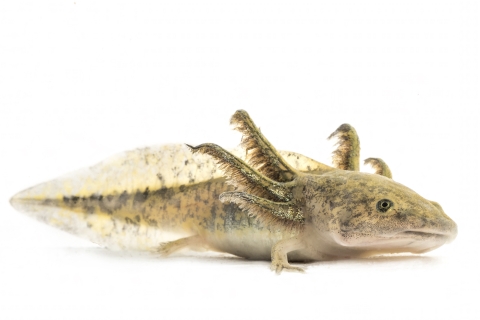
The larval form of the tiger salamander (either eastern, western, or California) looks very much like the axolotl, the famous Mexican lake salamander with frilly external gills.  That's no surprise - the animals are all very closely related.  Axolotls are an example of neoteny, the retention of juvenile features in adult animals.  They are, essentially, amphibian Peter Pans who never grow up... that is, unless you give them a hormone shot, in which case you'll soon wind up with an animal that looks very much like a tiger salamander.  

r/awwwtf - This is what a metamorphosed axolotl looks like
A metamorphed axolotl, picture from Reddit.  Axolotls often have pink/albino coloration in captivity, but if this was a brown, wild-type individual, it would probably look much more similar to a tiger salamander.

The reverse can happen as well - sometimes tiger salamanders do not complete metamorphosis and stay neotenic, retaining their gills and aquatic lifestyle, even as adults.  Interestingly, these "big babies" may be larger than tiger salamanders which do undergo metamorphosis!

So, you could go to a zoo and see two salamanders in side-by-side tanks, one aquatic with large external gills, the other terrestrial and lacking those gills, and actually not be immediately sure which is the tiger salamander and which is the axolotl (not that I've ever seen such a display.  Nor what I recommend it, either - from what I understand, forcing an axolotl to undergo metamorphosis shortens its lifespan considerably, so best to leave things as they are.   A good educational exhibit isn't always compatible with optimal animal welfare, so I try to err on the side of the later. 

Eastern tiger salamander larvae, from USFWS

Tuesday, July 8, 2025

Species Fact Profile: Western Tiger Salamander (Ambystoma mavortium)

                                              Western (Barred) Tiger Salamander

                                               Ambystoma mavortium (Baird, 1860)

Range: Western-Central Canada and United States
Habitat: Lowland Forest, Meadows, Semi-Desert, Streams
Diet: Insects, Slugs, Earthworms
Social Grouping: Solitary
Reproduction: Breeding can take place year round, influenced by rainfall and elevation.  Breed in temporary and permanent bodies of water.  Eggs (from 100-1000) are laid in the water either singly or in small clusters.  Complete metamorphosis to adult stage in 2-6 months, though some remain in larval stage for life (neoteny)
Lifespan: 20 Years
      Conservation Status: IUCN Least Concern

  • One of the largest North American salamanders, usually 7.5-16.5 centimeters, about 125 grams, but can be as long as 38 centimeters.  Broad head, stocky body
  • Dorsal color gray, black, or dark brown, with yellow spots, stripes, and bars.  Broad geographical variation in color and patterning.
  • Adults are primarily terrestrial, though usually found near water.  Spend much of their time underground in burrows, either dug themselves or by other species.   As juveniles, they have an aquatic larval stage with large, external gills
  • Larvae may be cannibalistic; cannibal larval morphs have enlarged mouths with bigger teeth
  • Introduced to southern Arizona after larvae were used as fishing bait 
  • State amphibian of Kansas and Colorado
  • Genus from the Greek for "blunt snout," referring to the broad head and rounded snout; species name references the Roman God of War
  • Sometimes considered a subspecies of eastern tiger salamander, A. tigrinum.  Five recognized subspecies: nominate, A. m melanostictum (blotched), A. m. nebulosum (Arizona), A. m. stebbinsi (Sonoran), and A. m. diaboli (gray)
  • Declines have been reported due to habitat loss and pollution.  Also potentially impacted by invasive fish and crayfish species

Monday, July 7, 2025

Weaponizing Wildlife

 I've spent much of my career trying, with varying degrees of success, to convince people that wildlife is meant to be cherished, not feared.  That includes all wildlife, even the species that we can consider scary.  Even animals that can undeniably be dangerous, maybe even lethal, to us, aren't monsters that seek to harm or kill people for the hell of it.  They're just... animals.  Trying to survive, independent of our own morals and values.

So even apart from all of the many, many objectionable aspects of it, I've not been a fan of the memes and jokes about the so-called "Alligator Alcatraz" that's been in the news so much.


That's not how alligators work.  They aren't going to patrol the edge of this camp, eating up any desperate escapees.  If that's how this worked, we'd never have poaching in any of our southeastern parks and reserves.  We don't use them for security guards at the zoo.  I've carelessly stepped over alligators before while cleaning their exhibits.  And when I see people snark about "Alligator Lives Matter" or "Alligators Need to Eat Too!" I just feel my skin crawl.  These are animals that I have a lot of fondness and appreciation of - great hunters and survivors, yes, but also wetland engineers and surprisingly tender parents.  They aren't props for a weird, B-movie fantasy.


Saturday, July 5, 2025

Satire: In the Name of the Deep Ones

You know, it really says something about the state of the world that I saw this, didn't see that it was from an obvious satire source, and felt the need to check to see if this actually happened or not.  And even after seeing that it was satire, if I saw this exact story in the news next week, I'd probably believe it.  I mean, what really gave it away to me in this case is that you wouldn't keep an octopus is an open-topped tide pool exhibit.  The Lovecraftian psychosis part I found completely believable.

"Ph'nglui mglw'nafh Cthulhu R'lyeh wgah'nagl fhtagn"


Friday, July 4, 2025

Sporcle Quiz: Endemic Animals - Made in America

Happy Fourth of July!  It's a holiday for celebrating all aspects of our country, including its bountiful natural heritage (while we still have it).  For today's quiz, see if you can identify which animals are American endemics - found in and only in the United States of America - while missing the decoys which can be found in other countries.  Enjoy!

Endemic Animals - Made in America


Wednesday, July 2, 2025

Take Me To Your Leader

 Embattled SF Zoo chief Tanya Peterson to step down

There had been long-standing, often bitter, simmering discontent at the San Francisco Zoo over the past several years, much of it aimed at the CEO, Tanya Peterson.  Peterson has been critiqued by many over the zoo's seeming stagnation, employee safety issues, and management of funds, so her announced departure after over 15 years at the helm has been welcome news to many.  But it does raise a question among many friends and supports of the city institution - who's next at the helm?

Traditionally, as in, before the 2000s, the leadership of most zoos was a director, one who either rose up through the curatorial ranks, or perhaps someone from academia - or, what was considered ideal, both.  That person often had intimate, specialized knowledge of the inner workings of the zoo, knew its facilities and animals closely, and had a deep, longstanding connection with the zoo's mission.  From about the 2000s one, directors began to be replaced by CEO/Presidents.  These were folks who often had business backgrounds - lawyers, bankers, etc.  It was thought that these folks who be able to use their business acumen and connections to strengthen zoos and aquariums, which are often on shaky financial footing.  To an extent, they've been successful.

This comes, however, with various costs.  It sometimes results in zoos where the emphasis shifts away towards community engagement and driving the gate over conservation and research efforts - the space that could go to a breeding pair of endangered macaws could instead be repurposed as a revenue-generating budgie aviary.  More of a focus on event space and rides than off-exhibit breeding and holding.  Greater focus on the ABC species (the animals everyone knows and recognizes) as opposed to animals that might be more cryptic, less well-known, but more endangered and with more of an impact on conservation programs.  And yes, as these new leaders tend to be very well compensated, more of a financial, professional, and philosophical divide between the folks at the top and the folks who make the zoo run at its most basic level.

Ideally, you can find someone who is knowledgeable about business and animals, someone who is deeply committed to the mission of the facility and is willing to make that a priority, a leader who promotes a culture and safety and welfare, who can raise funds like a pro and use the money wisely, rather than on ill-thought out schemes.  But such a leader might be the most endangered of all animals in the zoo.  Good luck to San Francisco on their search for such a unicorn...

Tuesday, July 1, 2025

Save the Worst for Last

This Bismarck ringed pythons may have been the loveliest snakes in our entire Reptile House - not that anyone other than the small team of keepers ever saw them.  That's because they were kept off exhibit, in a Neodesha (plastic, sliding-front) cage in the backroom, which, while fairly dull, made their bold, black and orange bands stand out that much more vividly.  I always paused to admire them when I came in first thing every morning, but I did not open the door to take care of them then.  No, I wouldn't open the door until the very end of the day, when I would change their newspaper, refill their water, and, depending on the day, maybe weigh them or feed them.  This was the last thing I would do every day, and then I would leave for home, and then take a shower.

On rare occasion, after servicing the ringed pythons, something last minute would pop up elsewhere in the building - maybe a water bowl would be found to have been knocked over, and in need to refilling, or a snake which we were waiting for a fresh fecal from just pooped.  In those cases, there wasn't much I could do, except ask someone else in the building to take care of it for me; or, if someone else had taken care of the ringed pythons that afternoon, they might ask me to clean up something in their section for them.  The understanding was that once you'd touched the pythons, you were - herpetologically speaking - done for the day.

A (presumably healthier) ringed python I photographed at on exhibit at another zoo

That's because our ringed pythons carried cryptosporidiosis, what we usually just called crypto.  Crypto, a parasite-caused infection, shed in the stool or contact with infected animals, can cause diarrhea, vomiting, weight loss, and death, and is one of the most feared diseases in reptile collections.  Our pythons had it and seemed to be perfectly healthy, but there was no guarantee - far from it, really - that any animal that was contaminated by them (with me or another keeper serving as an intermediary) wouldn't die an unpleasant death.  And as such, we made it the policy that the crypto snakes were the last animals to be cared for every day.

There were similar rules elsewhere in the building - healthy animals serviced before sick animals.  Snakes and lizards (generally) serviced before turtles and tortoises (chelonians being considerably germier).  It seemed like every day, there was a constantly changing list of "Do Me Last" animals - and then, among those animals, there was still a separate hierarchy of who was done first or last, with the ringed pythons retaining their place squarely at the end, or we'd each take a separate "last" animal to do at the end of the day.

Few areas of the zoo require keepers to care for so many and so different animals as the reptile house, and with the greater number of species and individuals, there are likely always to be animals with one medical issue or another.  Similar challenges may occur elsewhere in a zoo, but usually not to this scale or frequency (unless the zoo also has an aquarium).  Something as seemingly mundane as deciding which animals to take care of in which order can have major health consequences for hundreds of animals, perhaps the entire collection.